Gray Rocking, Gaslighting, and Guilt: Tools of the Abuser’s Trade

By Rebecca Witherspoon, July 8, 2025

Abuse doesn’t always come with bruises. It doesn’t always scream at you. It doesn’t always throw punches or leave visible marks. Sometimes, it’s quiet. Covert. Calculated. It unfolds through manipulation, emotional exhaustion, and the relentless erosion of reality.

That’s why we need to talk about how and why many victims choose to protect themselves, as well as two popular tactics abusers use to maintain control and keep the narrative in their favor—not just in homes and relationships, but in courtrooms, schools, churches, politics, and public life. Don’t be surprised if you find yourself nodding in agreement or thinking of personal examples as you read through this blog. But be forewarned: this one will be messy, uncomfortable, and highly personal.


Gray Rocking: The Survivor’s Last Resort

“Gray rocking” is a technique that many survivors use to protect themselves. It where victims or those trying to protect victims become emotionally unresponsive—boring, even—so that an abuser loses interest in them. Survivors often use this strategy because sometimes it’s the only way to protect themselves—despite what some may think, leaving an abusive situation is not always an option. Gary rocking becomes an important survival skill, because every emotional reaction can be a trigger point for the abuser. The abuser thrives on chaos, and any engagement—even defensiveness—feeds the cycle of abuse.

Gray rocking is self-preservation, not coldness. But when outsiders—teachers, friends, community members—see the survivor as “distant” or “unemotional,” they often misread the signals. They can fall into blaming the victim for the abuse. They might even call them unstable, bitter, or dramatic. All while the abuser plays the charismatic, composed figure who “just wants peace.”


Tactic #1 – Gaslighting: The Abuser’s Favorite Game

Gaslighting is the intentional distorting or twisting of the truth so thoroughly that the victim, or those trying to protect them, begin to question their own memory, sanity, and perception of events. It’s not just lying; it’s psychological warfare. It’s making the victim feel like they’re overreacting, misremembering, or even going crazy.

“I never said that.”
“You’re too sensitive.”
“You’re imagining things.”
“You’re making me out to be a villain.”

Does that sound familiar?

Abusers weaponize this tactic in both personal relationships and public life. They cast doubt on the facts. They undermine witnesses. They rewrite the narrative. They cry “character assassination” when held accountable. And they manipulate systems and institutions to help them get away with it.

Often the only way to combat this tactic is to maintain very clear records whenever possible—things like screenshots, recordings, etc. But confronting the gaslighting must be done cautiously to reduce the risk of further victimization.


Tactic #2 – Guilt: The Manipulative Glue

Guilt is one of the most insidious tools in an abuser’s arsenal—not because it’s loud or violent, but because it’s quiet, sticky, and often effective. It clings to survivors long after the abuse ends.

Abusers weaponize guilt to deflect attention from their behavior and keep the focus on the victim’s perceived failings. “You’re tearing this family apart.” “You’re so unforgiving.” “You’ll ruin my reputation.” “You’re doing this to hurt me.” These guilt trips aren’t random—they’re calculated. They’re meant to make the survivor feel responsible not just for the abuser’s feelings, but for the entire situation.

Over time, survivors internalize those messages. Even when they try to speak the truth, they’re haunted by self-doubt. Am I being too harsh? What if I’m wrong? Maybe I should just stay quiet to keep the peace. This is how guilt becomes the glue that binds victims to silence—and keeps abuse hidden in plain sight.

But let’s be clear: speaking up is not an act of vengeance. It’s an act of survival. This series isn’t about bitterness—it’s about breaking free from manipulation, reclaiming the narrative, and making space for accountability and healing.


Institutions Can Enable Abuse

In a perfect world, institutions—like schools, courts, or local governments—should serve as neutral protectors of fairness, due process, and accountability. But in reality, these same institutions can be manipulated to shield abusers and re-victimize those who have already been harmed. Instead of standing with victims, they can instead protect the status quo. Especially when decision-makers are unfamiliar with the tactics of abuse, are politically motivated, or are simply conflict-averse, the result is often harmful neutrality. They claim they’re “staying out of it” or “not taking sides,” but what that really means is refusing to acknowledge truth when it’s uncomfortable or politically inconvenient.

In my own experience, the schools re-victimized my family by refusing to believe my children—not because there was no evidence, but because they didn’t like the personalities of my children. Our church, meanwhile, tried to spiritualize the trauma, suggested that we should forgive the abuser, and even tried to blame the children for what was done to them. The abuser, a well-known ministry leader, was more than willing to play the part of the misunderstood victim. The institutions gave him cover and never once reached out to us to help us heal.

And now? That same dynamic is playing out in our local political arena.

Certain people are attempting to elevate someone with a troubling background into public office, despite the public record. It’s almost as though the red flags make this person appear to be a useful puppet who can be easily manipulated and controlled by those behind the scenes pulling the strings. And those people are attacking anyone who dares to point out the truth. Using guilt. Using gaslighting. Weaponizing community loyalty, a sympathetic “victim,” and spinning the truth into a smokescreen.


A Local Scandal Reveals That This Is Bigger Than Just One Family

As others chose to open a door I wasn’t sure I wanted to open, it seems the time has finally come to make something painfully clear. The same tactics that we see in abusive relationships are now playing out in real time in our local public and political arenas—and too many people are falling victim to the gaslighting and manipulation.

Take the current case involving Alicia Williams, who ran as a write-in candidate in last spring’s local Village Board race and has recently declared that she will be running as a registered candidate in the impending recall election in my village in mid-September. A recent post on an anonymous Facebook page called “Truth of the Village”—which made its debut during last spring’s race and actively promoted her write-in campaign while spreading disinformation and defamatory accusations against a couple of incumbents who were running for re-election—is a prime example of the use of both gaslighting and manipulative guilt to deflect the focus off Alicia and onto those who called her credibility into question (see screenshot below—the author of this post sounds hauntingly familiar—oink).
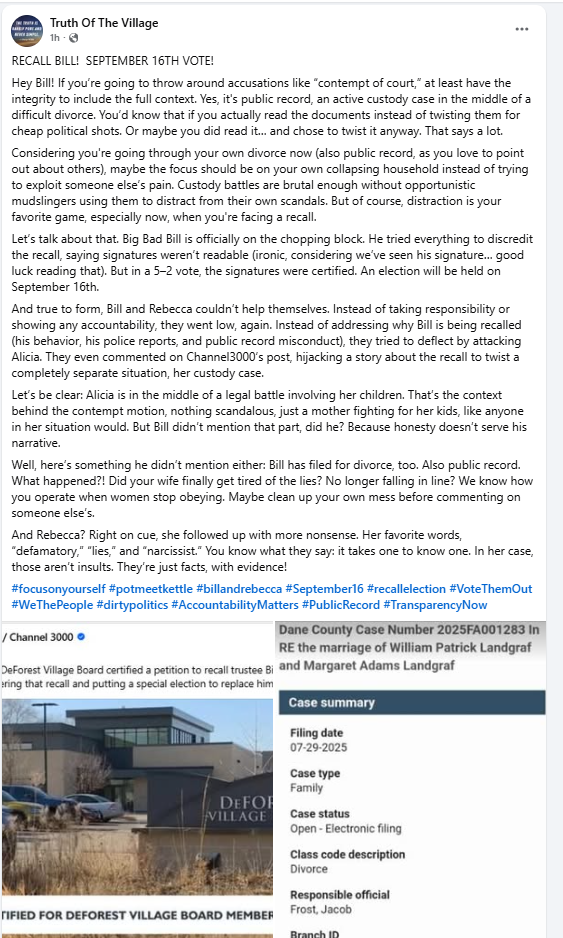
According to public records, Alicia took her two sons to a foreign country without notifying their father or receiving his permission, without informing their school, and without securing court approval. The public record also indicates that she even asked her children to lie about the trip. If the court does find her in contempt, this isn’t just a violation of a custody order—it could even rise to more serious legal consequences under both state and federal law. Some jurisdictions take this type of behavior very serious.

But instead of acknowledging her inappropriate behavior, the hearing has now been delayed three times—at her request. The first time right around the time of last spring’s election, the second time when the campaign to collect signatures for the recall was getting underway, and once again to just a few days before the recall election happens. Are you beginning to see a pattern?

So, no matter how “Truth” of the Village tries to gaslight, the real truth can be read in black and white and it has nothing to do with her trying to “protect” her children. This appears to be more about her attempting to avoid accountability for knowingly violating a court order—and then playing the victim when discovered. The real scandal isn’t what’s being said about her. The real scandal is her actions, how she has repeatedly tried to delay consequences, and how her supporters repeatedly gaslight and attack anyone who dares to speak the truth.

And this is not the only legal complaint Alicia is currently facing. She is still facing a complaint regarding alleged violations of campaign finance law, which has yet to be fully adjudicated, related to how she conducted her write-in campaign last spring, as well as issues with several donations made to her campaign. This includes one donor who used a fictitious name and address to unlawfully and deliberately hide their true identity, and another donor who purposely misrepresented where they live.

A troubling pattern emerges when the contempt of court motion and the campaign finance violations complaint are seen in the context of the much larger picture revealed by the public record—which describes highly disturbing allegations regarding her treatment of her children and the lack of accountability. More on that another time.


This Isn’t Just About Abuse Survivors Anymore—It’s About All of Us

You don’t have to be a survivor of child abuse or domestic violence to be impacted by this. If you live in a place where truth is punished, where manipulation is rewarded, and where institutions protect bad actors in the name of convenience or political expediency, then you are already living inside an abusive system. And systems like that don’t collapse on their own. They’re either confronted or they’re allowed to grow stronger.

When these dynamics are allowed to fester unchecked—whether in homes, churches, schools, or political campaigns—they don’t just harm individual survivors. They can infect an entire community. Because the real danger of these abuse tactics isn’t just what they do to one person. It’s how effectively they convince everyone else to look away.

When people excuse contempt for the law, when they attack those who raise legitimate concerns, when they rush to defend someone because they’re useful to a particular cause or agenda, that’s when we move beyond personal harm into collective corruption.

Sadly, we’re seeing this pattern play out right now in real time. Gaslighting isn’t just happening behind closed doors; it’s being deployed publicly to discredit facts and silence critics. Guilt is being manipulated at the community level, weaponized to frame accountability as cruelty. Survivors and truth-tellers are forced to either “gray rock” their communities or face the very real risk of being targets of smear campaigns.

We must learn to recognize these patterns. We need to trust the public record. And we must refuse to be emotionally manipulated by false narratives. Because this isn’t just about Alicia Williams. And it certainly isn’t just about what happen to me or my family. We are merely prime examples of a larger and much uglier picture. It’s about whether we’re willing to allow abusers, enablers, and gaslighters to write the story for all of us—or if we are willing to stand up for the truth, regardless of how uncomfortable the truth may be.

If we don’t call it out, we become part of the problem.


If Something Feels Wrong, Trust Your Gut

Children can’t always speak up—but you can. You can be their voice.

If something feels off, don’t ignore it. Say something. Make a report—even anonymously—so children and families can be protected without you being exposed to retaliation.

  • If you see someone minimizing a legal violation, discrediting victims, or surrounding themselves with enablers—pay attention.
  • If someone’s words don’t match their history, or if concerns are always met with deflection or accusations—pay attention.
  • And if a person under active scrutiny is being publicly propped up by those who know better—speak up.

Silence protects abusers.
Truth protects communities.


In Dane County, Wisconsin, suspected abuse or neglect can be reported 24/7 to:
📞 Dane County Child Protective Services (CPS): (608) 261-5437
🌐 https://dcf.wisconsin.gov/reportabuse
Your name can remain confidential—even to the person being reported.


One Final Note

If you’ve been gaslit, silenced, or painted as the aggressor for telling the truth, you are not alone. This tactic is as old as time. But together, we can break the cycle.

We do that by refusing to reward those who manipulate.
We do that by standing with the vulnerable.
And we do that by choosing integrity over image—no matter the cost.

Together, we can create a safer, more accountable community—one voice at a time.

* It’s a good thing I was able to set the record straight. What if people had gotten the wrong impression from the “Truth” of the Village post and thought that Alicia was in the middle of a divorce and then they found out that Justin is actually married to someone else? That could get real awkward real fast!

** If statements made by this and other supporters of Alicia are shown to be gaslighting meant to hide the truth about her actions or to spread malicious disinformation about her political opponent(s), why would you believe anything these people ever say?

Weaponized Victimhood: How Abusers Flip the Narrative

By Rebecca Witherspoon, August 6, 2025

In a healthy world, abuse would never happen. But even in a less-than-perfect world, we would hope that when abuse occurs—whether emotional, physical, sexual, spiritual, or psychological—the victims would be believed, supported, and protected.

Unfortunately, that’s not always what happens.

Far too often, those who commit abuse have become disturbingly skilled at flipping the script—casting themselves as misunderstood or persecuted, while portraying their victims as unstable, manipulative, or even dangerous. This tactic, known as weaponized victimhood, isn’t just emotionally damaging. It’s a calculated strategy used to discredit truth-tellers and preserve abusive power.

A Personal Experience—Then and Now

I’ve lived this reality more than once.

Years ago, my family experienced deep trauma at the hands of my now ex-spouse. After he was arrested for crimes committed against us, the re-victimization began—not from him, but from those who should have stood by our side.

At the time, he was a respected figure in our church. Though he never publicly denied his actions, he carefully curated a narrative of repentance and misunderstanding. And the church bought it. No one reached out to check on the children or me. The pastor blamed us, calling the children “exaggerators” and urging me to forgive and reconcile. Their priority wasn’t truth or healing—it was image control, hierarchy, and a warped sense of Biblical loyalty. They mistook performative remorse for genuine repentance and enabled him to manipulate the community further.

It didn’t stop there. Certain school staff—teachers, administrators, and even a nurse—responded to my children’s trauma not with support, but suspicion. Rather than protecting and believing them, they questioned their credibility and scrutinized their behavior. In doing so, they handed the abuser exactly what he wanted: control over the narrative and further isolation of his victims.

But we were lucky in one critical way: law enforcement and the courts never wavered. They believed us. They acted. And our closest friends and family—some of whom remain in our lives today—stood with us through the fire. The justice system, though imperfect and plagued by insufficient penalties for crimes against children, at least recognized the truth.

Unfortunately, this is not the norm.

The Broader Pattern

Today, I’m watching a familiar pattern unfold again—this time in my own community.

I’ve become the target of a public, coordinated smear campaign led by individuals who disagree with my politics and advocacy. They have used fake social media accounts, public defamation, and manipulative messaging to discredit me—mirroring the very tactics I’ve seen abusers use time and again.

And at the center of this campaign is someone with a deeply troubling pattern of behavior—someone who has become adept at weaponizing their own narrative. I’ve seen them cry in the right rooms, flatter the right people, and gain sympathy from those who should know better. They’ve surrounded themselves with enablers—some of whom are actively helping them attack those raising legitimate concerns. These aren’t just misguided bystanders. They are strategic actors with personal agendas.

Meanwhile, the children caught in the middle remain vulnerable—waiting for adults to put aside politics and personal comfort and choose to protect them.

Why This Works—and How to Break the Cycle

This dynamic works because many people struggle to sit with discomfort. They crave simple stories: a hero and a villain. But abuse and its aftermath are rarely simple. Abusers exploit this discomfort. They present themselves as calm, composed, and likable—while their victims may appear emotional, angry, or “too much.”

And so, the abuser is believed. The victim is dismissed.

It happens in homes, churches, schools, and even in public discourse. And now, in an age of social media and curated personas, it’s easier than ever to perform victimhood in order to escape accountability and destroy others.

So What Can We Do?

We start by recognizing the signs—not just of abuse, but of manipulation. We stop confusing performance with truth. We resist the urge to default to the person who “seems” more composed or familiar. We pay attention to patterns—because over time, patterns don’t lie.

Most importantly, we listen. Especially when the voices being dismissed belong to children.

When something doesn’t sit right in your gut—trust your gut. Don’t look away.

If You See Something, Say Something

If you’ve tried to speak out and found yourself painted as the aggressor, you are not alone. This tactic is old—but that doesn’t make it any less dangerous.

You can help by taking responsible action:

  • Listen carefully to those who raise concerns—even if their emotions make you uncomfortable.
  • Ask hard questions when something doesn’t add up, especially if a pattern of troubling behavior or inconsistent storytelling emerges.
  • Speak up—not recklessly, but responsibly.
  • Report abuse or neglect, especially when children are involved.

This isn’t about vendettas or disagreements. It’s about protecting the vulnerable.


If Something Feels Wrong, Trust Your Gut.

Children can’t always speak up—but you can. You can be their voice.

If something feels off, don’t ignore it. Say something. Make a report—even anonymously—so children and families can be protected without you being exposed to retaliation.

In Dane County, Wisconsin, suspected abuse or neglect can be reported 24/7 to:
📞 Dane County Child Protective Services (CPS): (608) 261-5437
🌐 https://dcf.wisconsin.gov/reportabuse
Your name can remain confidential—even to the person being reported.


Together, we can create a safer, more accountable community—one voice at a time.

The Court Said No: What Happens When Protective Parents Aren’t Believed 

By Rebecca Witherspoon, August 4, 2025

There are few moments more gut-wrenching than standing in front of a judge, pleading for your child’s safety, and hearing the word: Denied.

It’s the moment every protective parent dreads—when the very system that is supposed to safeguard your child instead decides that your evidence isn’t strong enough, your words aren’t convincing enough, or your fear isn’t rational enough. It is a moment that can leave you breathless. Hollow. Terrified.

Over the past number of years since my family went through our ordeal, I’ve had friends tell me their own horror stories including things like, “I tried to speak up.” “I tried to alert authorities, but I was ignored.” “I tried to make a report.” “I tried to get the courts to listen.” But still, they were told to sit down, be quiet, stop stirring up trouble. In some cases, they were even accused of being dramatic, vindictive, or even mentally unstable.

I know exactly how that feels.

When I finally found the courage to speak out about what was happening in my home, it wasn’t just the abuse that terrified me, it was the fear that no one would believe me. And in some cases, they didn’t, or at lest not until the damage was irrefutably undeniable. And even after that, there were some people in the community where we lived at the time—some people in positions of influence—who continued to pretend nothing had happened and that my children and I were the actual problem.

This is what happens far too often in custody cases where abuse is involved. It becomes a he-said/she-said situation with the children stuck in the middle. Unless there is undeniable evidence—bruises, broken bones, burns, or other visible injuries—courts are often reluctant to take sides. So, a protective parent gathers up the strength to report what their children have told them. They follow the rules, hire the experts, document the evidence, seek therapy, call CPS, attend every court hearing. And still—the court says no. No change in custody. No supervised visitation. No immediate protection. And in some devastating cases, the court gives the abuser even more access to the child and might even penalize the reporting parent for harassing the abusive parent.

When people ask, “How could this happen?” the answer is complicated—but the truth is, this happens more often than most of us want to believe.

Courts often favor maintaining the status quo—especially when it might mean interfering with a parent-child relationship. They are trained to prioritize “co-parenting” even in situations that are clearly unsafe. Judges may be overworked, underinformed, or heavily influenced by outdated beliefs about family dynamics. In some cases, they actively dismiss abuse claims, especially if those claims don’t come with visible bruises, the children are threatened by the abuser into making contradictory statements, or if the abuser presents well in the courtroom.

And that’s how children are sent back into homes where they continue to live in constant fear. That’s how protective parents end up vilified. That’s how abuse persists under the false banner of “shared parenting.”

The hardest part is watching the aftermath. Children confused and hurt by a system that doesn’t protect them. Parents who do everything right, only to be accused of alienation. Communities who watch the drama unfold before them but convince themselves it must not be that bad—because surely, the court wouldn’t have allowed it otherwise.

And yet—here we are.

I’m seeing the same dynamics play out again right now. A protective parent raising red flags. Clear concerns being documented for years. Children struggling. And still, people asking, But where’s the proof? Or worse: Well, she seems like such a good mom.

And yes, she might seem like one. That’s how this works.

Sometimes the person causing the harm hides behind charm and image. Sometimes they are shielded by political alliances or by those who see them as useful to a bigger agenda. Sometimes they are simply so convincing in their performance that people stop looking any deeper. Or they choose not to. Because the truth would be too inconvenient.

And once again, children are caught in the middle.

This isn’t just a tragedy, it’s a failure. A failure of systems, a failure of due diligence, a failure of courage, and a failure of community.

They say a person can only wear a false mask for so long before it begins to slip and their true self is revealed. Patterns emerge over time—not just in moments of abuse, but in a broader pattern of behavior. It’s in the belief that the rules don’t apply to them. In the violations of custody orders. In coercing children to lie in order to cover their misdeeds. In a repeated failure to face consequences for breaking traffic laws and other legal boundaries. In the manipulation of the court system—delaying hearings again and again to preserve a certain public image, perhaps even for political gain. So when do we, as a community, finally say: Enough? When do we start holding abusers accountable for what they’ve done?

I don’t write this to sensationalize anything. I write this because it’s happening. Right now. In plain sight. And if we don’t start believing protective parents before it’s too late, we will keep failing the very people we claim to care about most—our children.

If you’ve been paying attention, you know this isn’t over. But for now, ask yourself, when a parent comes forward to say their child is not safe, what does it cost us to believe them at least long enough to investigate the validity of their claims?

And what does it cost the children when we don’t?

If Something Feels Wrong, Trust Your Gut.

Children can’t always speak up—but you can. You can be their voice. If you see or sense something that feels off, don’t ignore your instincts. Say something—but do so responsibly. This isn’t about personal vendettas or disliking someone. It’s about protecting the vulnerable and doing what’s right. You can make a report anonymously to help safeguard children and families—without exposing yourself to retaliation.

In Dane County, Wisconsin, suspected abuse and/or neglect can be reported 24/7 to: 

Dane County Child Protective Services (CPS)
📞 (608) 261-5437
🌐 https://dcf.wisconsin.gov/reportabuse

Your name can remain confidential—even to the person being reported.

 Together, we can create a safer, more accountable community—one voice at a time.

Why Speaking Up Feels So Hard—Even When We Know We Should

By: Rebecca Witherspoon, August 1, 2025

After the first post in this series, a number of people reached out to say they’ve seen things—moments, interactions, red flags—that made their stomach turn. But they didn’t speak up. Or if they tried, their concerns went nowhere. Some admitted they were still afraid to say anything even now because they’ve personally witnessed anyone who spoke up experience coordinated and very public smearing of their name and reputation. The result was that people quit talking about what was happening out of fear they would be the next target. They went to ground to protect themselves.

That hesitation isn’t surprising. Honestly, I get it.

Even when people want to speak up, even when every fiber in their body is screaming that something just is not right, there’s often a voice in the back of their mind that says: “What if no one believes me?” “What if I make it worse for the kids?” “What if I become the target?”

And those aren’t irrational fears—they’re rooted in very real lived experiences of many people who have spoken up before. Many of us have seen what happens when someone tries to call out abuse or neglect. Too often, nothing changes for the better—and the person who raises the alarm ends up isolated or even punished. Sometimes, even the children suffer more. I know. I’ve been there. I’ve just gotten to the point where I’m no longer willing to be silent. I’ve already had my name and reputation smeared by malicious lies for months, what’s a few more false attacks against me. I know who I am. I know the truth. I know how to protect myself. People who actually know me also know the truth and see through the many lies floating around on various social media platforms. I will not stand by while I see children suffering needlessly.

I’ve lived through the fear that overwhelms you when you’re living in the middle of a crisis like this. When I finally got to the point where escape was the only option, I was petrified. Not just because of what my children and I had endured, but because of what could come next. The questions kept running through my mind, “What would happen to me or my children if I spoke out? What if the courts don’t believe us? What if the school looks the other way? What if our community doesn’t want to hear the truth?

Unfortunately, some of those fears came true for us.

Even after my then-husband went to prison for what he did to my family, we still experienced re-victimization by some community members and certain school personnel who didn’t want to believe the truth. People who preferred to cling to the false image they had of him—charming, personable, smooth talker—rather than face the ugly truth that he had shattered my family from the inside.

And now, all these years later, I’m watching something that feels hauntingly familiar play out in our community.

I watch as people rally around someone they barely know. I see them trying to elevate someone to a position of trust and leadership—despite very public and concerning patterns in their background. Some have chosen to see only what they want to see—passionate, well spoken, and maybe even a bit “fiery.” Some have chosen to ignore the rest. Or they excuse it. Or they publicly attack anyone who tries to tell them there’s more to the story.

Some of those warning signs have been present for a long time. Some have come out more recently. And yet, the louder the truth is whispered, the harder some folks work to drown the truth out. Even after some information was publicly revealed, I’ve seen certain people choose to brush off the warnings and prop this person up. It’s almost as if this person is seen as a useful tool to achieve a particular political agenda—because they may believe this person can be manipulated enough to help push their agenda forward, no matter who gets hurt in the process. In many respects I truly feel sorry for this person because they probably believe they are the one in control when in fact it’s actually others in the background who have been pulling the strings and pushing their agenda in our community for years. And when they are no longer useful, what then?

But this blog series isn’t about that person. This series is about the children—the innocents caught in the crosshairs. And about how we, as a community, either become their advocates or bystanders to what they are experiencing. And right now, some very brave people are trying to speak up about what’s been happening to these kids—they have been silenced or dismissed for far too long. They deserve better. And so do the children. All of this is public information available to anyone … if you’re open to learning the truth.

But we cannot help the children if we cannot even admit that there’s a problem. And we certainly cannot protect them if we continue protecting the image of someone who has been accused of harming and may be continuing to harm them—directly or through proxies.

I know how heavy this is. How complicated. How personal it feels for some. I also know how easy it is to look away, or say it’s not your place. Or tell yourself the system will take care of it.

But if the system has already failed? Then what?

We have to talk about what fear does to people. How it paralyzes us. How it turns silence into a shield. How good people end up doing nothing, not because they don’t care, but because they’re overwhelmed, uncertain, and afraid of doing the wrong thing.

This is not about guilt or shame. It’s about breaking the paralysis of fear and silence. It’s about making room for uncomfortable truths. It’s about standing with the people who are telling the truth—even when it’s inconvenient. Even when it makes us uncomfortable.

Because the cost of silence is always borne by those who can least afford it … the children.

And that’s why I’ll keep writing. Because I’ve been the parent who tried to protect her children while the world looked away. And I’ve watched what happens when nobody wants to believe the worst—even when the evidence is right in front of them.

More is coming. And I promise you—what’s next in this series is going to be hard to read. But it’s even harder to live through. And too many already have.


If Something Feels Wrong, Trust Your Gut.

Children can’t always speak up—but you can. You can be their voice. If you see or sense something that feels off, don’t ignore your instincts. Say something—but do so responsibly. This isn’t about personal vendettas or disliking someone. It’s about protecting the vulnerable and doing what’s right. You can make a report anonymously to help safeguard children and families—without exposing yourself to retaliation.

In Dane County, Wisconsin, suspected abuse and/or neglect can be reported 24/7 to:
Dane County Child Protective Services (CPS)
📞 (608) 261-5437
🌐 https://dcf.wisconsin.gov/reportabuse
Your name can remain confidential—even to the person being reported.

Together, we can create a safer, more accountable community—one voice at a time.

When Systems Fail: The Silent Cost of Looking Away

By: Rebecca Witherspoon, July 30, 2025

It starts as a quiet discomfort—something you see, hear, or sense that just doesn’t sit quite right. Maybe it’s a child’s demeanor that shifts overnight. Maybe it’s a parent’s behavior that seems overly performative or oddly defensive. Maybe it’s the way institutions close ranks when you ask uncomfortable questions they’d rather not answer. You tell yourself not to jump to conclusions. You start to second-guess your instincts. And then … you move on.

And that is how the cycle begins and continues.

We’d all like to believe that if a child was truly in danger, someone—anyone—would step in and say something to help that child. We assume that schools, courts, counselors, and agencies are watching closely enough to intervene when things go wrong. But too often, that faith can be misplaced. Even when warning signs are loud and clear, even when children repeatedly confirm something has happened, even when there is a clear and—in some cases—lengthy record of serious allegations, the systems we rely on can utterly fail to protect the children who need them most.

This series isn’t about a single case. It’s not even about politics or personalities. It’s about patterns—patterns that play out in community after community, often in plain sight. Patterns that many of us sense, but too many of us hesitate to acknowledge or confront.

I speak from deeply personal experience. My own family lived through the kind of trauma most people think only happens to “other people.” My former spouse—who suffered from delusions and paranoid schizophrenia—terrorized me and my children to the point that I was paralyzed by fear, truly believing that if I tried to leave, he would kill us. It took everything I had to finally break free, and unfortunately only after he’d done the unthinkable to one of my children. He was eventually sentenced to prison for what he did, but served only one year—a slap on the wrist for one of the most heinous crimes imaginable. The real sentence was left to me and my children including years of pain, healing, and the added trauma of being re-victimized by school personnel and others in our community who simply didn’t want to believe what had happened—even after a conviction.

Our trust in “the system” was shattered—not just by the abuse itself, but by the ongoing denial and resistance we faced as we tried to rebuild our lives. We fought tooth and nail for healing, and we’re still healing—more than 25 years later. That journey is part of why I’m writing this series. I don’t speak from theory. I speak from lived experience, and I know what it feels like when people look the other way. I’m no longer willing to look the other way when I see the signs and the evidence is staring me in the face.

So Why Do We Look Away?

We look away because the truth can feel extremely uncomfortable. Because we don’t want to be wrong. Because we don’t want to be accused of “starting drama” or “meddling in someone’s personal life.” Because sometimes the person in question is well-connected, has a charming facade, or is someone popular—or even in power. It might be someone running for political office, someone in your church, or someone in your children’s school. It could be someone you’ve trusted to care for your children. Sometimes, it’s even the parent of the very child you fear is being abused. And sometimes—frankly—we just don’t want to believe that the people around us could be capable of something so evil, especially toward a child.

But even when we do want to speak up, directly calling out abusive behavior can feel far too risky—especially when others have tried before, only to see the abuser face no consequences, the children suffer retaliation, and the person who raised the alarm become the next target.

So the question becomes: How can someone speak up without causing further harm to the children or putting a target on their own back?

The reality is that abuse, neglect, and the endangerment of children don’t always come with bruises or news headlines. Sometimes it’s hidden from public view and shows up as children being forced to live in chronic fear—When will I be screamed at again? When will I be hit again? When will they burn me again? When will my belongings be thrown out the window? When will they touch me in “that” way again?

It can also take the form of one parent being silenced by the abusive parent—through unfair custody agreements or very real threats of retaliation if the protective parent dares to speak up. It can even come from a system that tells victims their word isn’t enough, and that they must wait their turn, stay quiet, or prove it all over again.

If children can’t trust the very people who are supposed to protect them, who can they trust? And when courts and other systems fail to hold the abuser accountable, chronic fear takes hold—and hopelessness becomes the abused child’s reality.

The Failure Is Systemic

When the courts grant full or partial custody to a parent with a known history of allegations of abuse—because they “can’t be sure”—that’s a failure. When schools and counselors report suspected abuse, but nothing happens, that’s a failure. When a protective parent is threatened with retaliation for trying to shield their children by the abusive parent, that’s a failure. When communities rally behind someone without doing their due diligence—ignoring and even attacking anyone who dares to speak up—simply because that person fits a political narrative or serves as a convenient puppet for manipulative actors, that is also a failure. And when no one is willing to step forward and call out those who perpetuate and enable the continued abuse, that’s a failure.

This blog series will explore the many forms of institutional and community silence—from family courts to school districts to political circles. We’ll examine how manipulative individuals exploit these systems and leverage abusive individuals to advance their own agendas. We’ll also look at how good people are pressured or intimidated into silence, and how the true cost is ultimately borne by children, protective parents, and entire communities

This Is About More Than One Child. It’s About All of the Children.

Every child who slips through the cracks represents a community failure. Not because we can prevent every bad actor from existing, but because too often, we make it far too easy for them. We give them cover with our silence. We hand them credibility when we ignore the signs and promote them uncritically. We diminish victims and tell them they aren’t worthy when we pretend not to see.

Over the coming weeks, this series will take a deep, thoughtful look at:

  • The warning signs of different types of abuse
  • How abusers manipulate court systems and public opinion
  • The toll on protective parents, educators, and children themselves
  • What real community accountability and advocacy should look like

It’s not enough to shake our heads in hindsight. We need to build a culture of proactive vigilance. A community where we hold each other to higher standards—not for the sake of power, but for the sake of people, and because it’s the right thing to do.

If you’re uncomfortable already, good. That means you’re actually paying attention.

Stay with me. It’s time to talk about what too many people have chosen to ignore and are too afraid to expose. It’s time to do the right thing.


If Something Feels Wrong, Trust Your Gut.

Children can’t always speak up—but you can. You can be their voice. If you see or sense something that feels off, don’t ignore your instincts. Say something—but do so responsibly. This isn’t about personal vendettas or disliking someone. It’s about protecting the vulnerable and doing what’s right. You can make a report anonymously to help safeguard children and families—without exposing yourself to retaliation.

In Dane County, Wisconsin, suspected abuse and/or neglect can be reported 24/7 to:
Dane County Child Protective Services (CPS)
📞 (608) 261-5437
🌐 Reports can also be made via WI Department of Children and Families at https://dcf.wisconsin.gov/reportabuse
Your name can remain confidential—even to the person being reported.

Together, we can create a safer, more accountable community—one voice at a time.

Why You Might Not See Me Around for a While

By: Rebecca Witherspoon, July 11, 2025

I’ve always believed in being transparent, especially with those who follow my work, my writing, and my service to the community. So I wanted to share why I might not be as present—in person, online, or in politics—for the next few months.

Last week, my husband underwent urgent spinal surgery to remove part of a large tumor pressing against his spine. Due to the tumor’s proximity to his spinal cord, it wasn’t possible to remove it all. The surgeons also had to place rods, screws, and pins into his thoracic spine, as one of his vertebrae had been destroyed by the tumor. While we’re grateful for the skilled hands that performed this complex surgery, he is now facing a long and painful recovery—one that requires both time and constant care.

This is not his first battle with cancer. He’s already been managing two separate types of cancer for many years – one thankfully well-controlled and the other a bit more complicated. But this most recent diagnosis has introduced a new and uncertain chapter in our lives. We’re still learning the extent to which this disease has already affected his body, and we don’t yet know how he’ll respond to treatments or even what his long-term quality of life will look like.

What we do know is that this cancer is not curable and is most likely terminal. And yet, we’re at peace. Our focus is not just on fighting disease, but on preserving dignity, purpose, and love through whatever lies ahead. Maintaining a positive and faith-center perspective is so important. We live in a world where the just and the unjust alike suffer, and we are not immune to suffering simply because we have faith in the God of this universe. For “we know that God causes all things to work together for good to those who love God, to those who are called according to His purpose.” That doesn’t mean that suffering is eliminated, it just means that God has it all worked out already. Our job is to walk our journey with our eyes focused on Him and He’ll work it all out according to His will, whatever that may be.

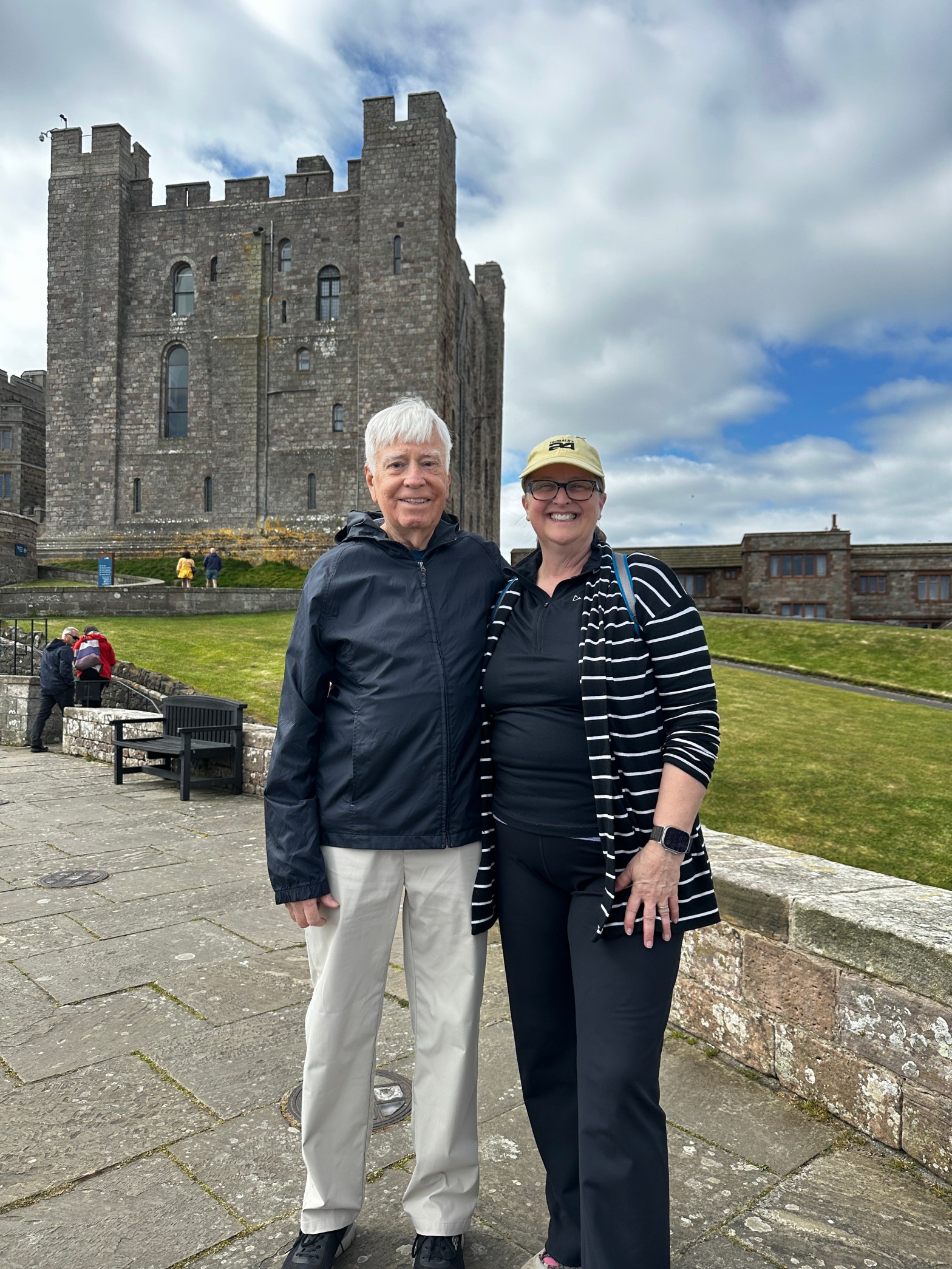
Rebecca and her husband looking out over the Firth of Forth from Calton Hill in Edinburgh, Scotland (May 26, 2025)

In light of all this, my priorities have shifted. I will still be here—but my presence will be quieter, more focused. My blog may not be updated as regularly. My political activity will be significantly reduced for now. Instead, I’ll be prioritizing what matters most: caring for my husband, fulfilling my responsibilities at work and as a village trustee, and taking care of myself amidst it all.

When I do return to writing, you may see my focus shift a bit—toward healing, caregiving, truth-telling, and navigating life with grace in hard times. But rest assured, I’m not going anywhere.

To our many friends, family members, community members, and colleagues who have surrounded us with prayers, meals, texts, encouragement, and even just your quiet presence—thank you. Your support means more than I can ever put into words.

And to those who have chosen these past eight months or so to spread falsehoods and to maliciously defame me and others in my community because you were offended by one our votes as Village Board members, you are not my priority—but you also are not forgotten. I remain committed to truth, transparency, and protecting the integrity of our local leadership. That work continues, even if my primary focus has shifted a bit … for now. As the saying goes, “The Truth shall set you free.” Some will accept the truth and others won’t—while I hope many will accept the truth, it’s not my responsibility to force people to open their eyes, just to put the truth in front of them. What they choose to do with it is up to them.

With peace and deep gratitude,
Rebecca

Grace and the Long Game: Walking Into the Light One Step at a Time

Making peace with the past, without pretending it didn’t happen.

By: Rebecca Witherspoon, July 4, 2025 

On July 4th, we celebrate the birth of a bold and complicated experiment—one rooted in the pursuit of freedom, truth, and collective possibility. It was never perfect. It was never easy. But it was a declaration that something better was worth striving for, even when the path forward was uncertain.

That’s the spirit this series was born from.

Not patriotism as performance, but resilience as a way of life. Not unity that papers over the truth, but community built on the courage to face it. That’s what this moment—this entire season—has asked of me. And maybe of you too.

Some people lead with microphones. Some lead with megaphones. Some lead with fear.

But the kind of leadership that actually heals a community? That’s the slow kind. The quiet kind. The kind that doesn’t always come with recognition, applause, or protection. It comes with consistency. With integrity. With the kind of grace that doesn’t mean softness, but stamina.

I’ve come to believe that real leadership isn’t about getting the last word—it’s about walking in the right direction long enough for others to notice the path.

Grace doesn’t mean you’re a doormat for everyone to walk over or a punching bag for them to repeatedly hit. It means you’ve decided not to let bitterness harden you. It means you can tell the truth without shaming people—something I will admit I have not always been perfect at in the heat of a moment. It means you can set boundaries without building walls. And it means you can keep showing up, even when it feels like no one’s listening—because you know who you are, and who you’re not.

This kind of groundedness doesn’t come out of nowhere. It’s earned—slowly, honestly, over time. And for me, it comes from having made peace with my own story. I was reminded of this a few days ago when someone said, “Past choices, even choices that you would now consider to be bad choices, make you the person you are right now, in this exact moment in time.”

I absolutely agree and I wouldn’t change a thing.

That might sound strange to say, especially when I think back on some of the mistakes I’ve made, or the painful and sometimes traumatic seasons I’ve walked through. But every choice—whether wise or deeply flawed—every person I’ve encountered, every joy, every heartbreak, every silence, and every outburst has shaped me into the person I am right now.

And I really like who I am. That’s not something I could say 20 plus years ago.

If I went back and tried to edit my story—remove the hard parts, soften the sharp ones—I might end up with something cleaner, but not necessarily stronger. Not necessarily real. The grace I try to live and lead with didn’t come from perfection. It came from the work of becoming. From learning. From stumbling and choosing to rise with a little more clarity, a little more compassion, and a little more courage each time.

This series began with a moment—a flicker of humanity that broke through the fog of distrust and grief. And that moment was made possible by two women. Each in her own way, they stepped out of the noise and into the light. Their simple, unforced gestures of kindness were not performative. They were real. Unscripted. Risky, even.

And they changed something in me—they shifted my focus—and helped me realize I was reacting to the negative actions of others outside of my control rather than just being the me that I have worked so hard to become.

They didn’t pretend to have answers—and in fact didn’t even offer answers. But what they did was enough to shift something in me—and, I believe, can in others too, if they’re willing to listen, to hear, and to act.

It was as if, just for a breath, we remembered what it felt like to see each other again. Not as enemies or factions or threats, but as human beings navigating our own pain, our own hope, our own longing for peace.

Their example reminded me that grace is not a passive thing. It’s a force. And when it shows up—even quietly—it has the power to cut through darkness. To interrupt cycles. To start something new.

That reminder changed helped me return to myself—to the steadier, quieter kind of strength I’ve spent years building. And that same reminder can help others move forward on a different path—a path toward forgiveness and reconciliation.

Not because it’s easy. Not because we’re always certain. But because we’ve decided that what’s at stake is too important to abandon. Because community isn’t something you inherit—it’s something you choose to build, again and again, even when others try tearing it down.

That’s the kind of freedom I’m choosing this Independence Day. The freedom to live without bitterness. To speak truth with compassion. To walk in integrity even when it costs more than silence.

You don’t have to hold public office to be part of the solution. You don’t need a title or a stage. You just need the courage to stay grounded. The discipline to speak carefully. The faith to believe that truth lasts longer than drama. That character matters more than control. That eventually, the long game of grace will outlast the short game of spectacle.

Not everyone will see it right away.
Some may never see it.
But some will.
And those that do see it will follow—not your voice, necessarily, but your example.

That’s how healing begins. That’s how we walk forward—together.

One steady, gracious step at a time.

When Silence Costs Too Much

Speaking truth with grace—even when it’s hard, unwelcome, or misunderstood.

By: Rebecca Witherspoon, July 3, 2025 

There’s a temptation—especially after you’ve walked through grief, forgiveness, and clarity—to believe that silence is the safest, most graceful option. That by staying quiet, you can somehow avoid conflict, preserve relationships, and keep peace. Silence has a cost. It can become a quiet consent for someone to continue their harmful behaviors. It can leave misinformation unchecked, allow division to deepen, and give weight to voices that thrive in the absence of challenge.

Speaking up isn’t always easy. It’s never without risk. Sometimes it makes you vulnerable to misunderstanding, criticism, and even worse. And sometimes, it feels like your words don’t matter—they fall on deaf ears or get twisted into something unrecognizable. I know, I’ve lived it.

But there is power in speaking up. Not with screams or calling out with venom. Not to seek to dominate or shame. And certainly not to stoop to the same level as those acting in harmful ways. Rather, speaking truth with intention, clarity, and courage. Refusing to allow your silence to become complicity.

Using your voice wisely means knowing when to speak—and when to listen. It means balancing courage with compassion, standing firm without pushing others away. It means remembering that words can either build bridges or walls. I chose a long time ago to be a builder, but recently, there are those that keep burning the bridges and building walls. And at times I have succumbed to pouring gas on the flames started by others. Unfortunately, these same people refuse to hear how their actions are harming people and have created an environment where dialogue and healing is nearly impossible. When those they seek to harm refuse to bow to their demands and instead speak truth into the hatred being spewed, they double and triple down in their harmful actions. No matter how much irrefutable truth is revealed to them, the truth is not what they are after—retribution for perceived wrongs (valid or not) is what they seek and nothing short of total destruction will appease their hatred and anger.

Over the course of many years, I’ve learned that leadership isn’t always about being the loudest. Sometimes it’s about being the calmest. Sometimes it’s about speaking up when it feels hardest and scariest, because you know that your silence will cost far more than your momentary discomfort.

We owe it to ourselves—and our communities—to use our voices not to tear each other down, but to build each other up and to heal. To invite dialogue where there is division. To shine light in the corners where shadows gather.

The cost of silence is far too high.

The power of speaking up—when wielded together with grace—is transformative. Sadly, not everyone will embrace the truth. But then truth really doesn’t care about your feelings.

When the Floor Gives Way

By: Rebecca Witherspoon, July 2, 2025

There’s a moment when everything just … stops.

Not in the dramatic, slow-motion kind of way they show in movies. There’s no music swelling, no camera zooming in on your face. Just silence. Stillness. Maybe a nod. A short, sharp breath. And then, nothing.

You hear the words, but they don’t hit right away. Not because they’re unclear—no, they’re perfectly clear, and they may even be expected—but because to hear them makes it real. It’s that they’re so clear, so final, so devastating, your body and mind must buy you time to process. So, you go numb.

The doctor might keep talking. You might even nod along and even ask a few questions. You might think you’re holding it together. But something inside you has suddenly disconnected. There’s a haze between the moment before and everything that follows.

You catch yourself staring at the wall and you realize you didn’t actually hear the last three minutes of what they said. Or maybe you did, but it didn’t stick. It couldn’t.

It’s a strange thing—to feel so full of emotion that you actually feel … nothing. Like your system short-circuited. And in a way, it has. That’s how the mind protects you when the ground disappears beneath your feet.

You walk out of the building, and the world keeps turning. The barista next door is laughing. Someone is jogging with a dog. People are arguing and fighting about things that ultimately aren’t important. Life around you is continuing like normal. But your life just shifted into something else. Something not invited and unwelcome. And there’s no script for what to do next.

Later, you might get in the car and just sit there. You might drive without remembering how you got home. You might cook dinner on autopilot, not even tasting the food. The numbness doesn’t ask for permission. It just settles in, quietly, and wraps itself around your every move.

People mean well. They’ll say things, offer to help, check in. But you’re in a different time zone now. A different reality. You want to scream, to rage, to disappear. Or sleep until you can wake up and discover this was all just a really bad nightmare. Or maybe just go back five minutes before you heard those words and stay there.

The truth is nothing prepares you for this. Not love. Not strength. Not faith. You just … show up. You get through one minute, one hour. Then the next, and the next. You say “we’re okay” when you’re really not. You keep breathing because others need you to, and because you don’t know what else to do. You do anything to distract yourself from dwelling.

Eventually, the numbness starts to wear off. Or it cracks in places. And underneath it, the grief begins to stir. But so does something else—something you may not have expected—gratitude. Not the easy, everyday kind, but a deep, almost unspeakable kind. The kind that wells up when a friend checks in without asking for details. When someone drops off food without expecting a thank-you. When someone simply says, “I’m here,” and means it. A peace that surpasses all understanding.

Every kind word, every thought, every prayer—no matter how small—starts to feel like a lifeline. You realize how much it matters. You realize that even though people can’t fix things, their presence helps you carry the weight. And you silently thank them, even when you can’t find the words to say out loud.

The sharp edges of life get sharper. What matters most becomes crystal clear. And all the petty noise, the nastiness, the drama—it all fades. You stop caring about proving points, or being right, or entertaining bitterness. There’s no energy for it. There’s no point.

Because now, it’s about the here. The now. One moment at a time. One foot in front of the other. Being strong for someone you love, even as your own heart breaks. Holding their hand while you steady your own feet. Being present, even when it takes everything you have.

And this is just the beginning. The road ahead is unknown. There will be ups and downs. There will be moments of unbearable heaviness, followed by strange calm. It will be a rollercoaster—emotionally, physically, mentally. But knowing you’re not walking it alone makes all the difference.

There’s no map for what comes next. But with love surrounding you, kindness holding you up, and real people standing quietly in your corner, you keep going.

And that’s what matters now—love, being present, and the steady rhythm of choosing to show up—even in the face of devastation. Especially in the face of devastation.

You don’t have to know how to do it all. You just have to keep going and allow the kindness surrounding you to do what it was always meant to do—remind you that you’re not alone.